1. Home
  2. The ten levels
  3. Level A

Calibrated Practice

CAT4Level A

Ages 8–9Year 4 in UK schools

648 questions, and every one of them explains all five options. All eight question types taught before they are tested, then three complete mock tests. For the child who says “I just guessed”.

Paperback, 8.5 × 11 in, 281 pages. Revised edition, November 2026. ISBN 979-8-17-706606-6.

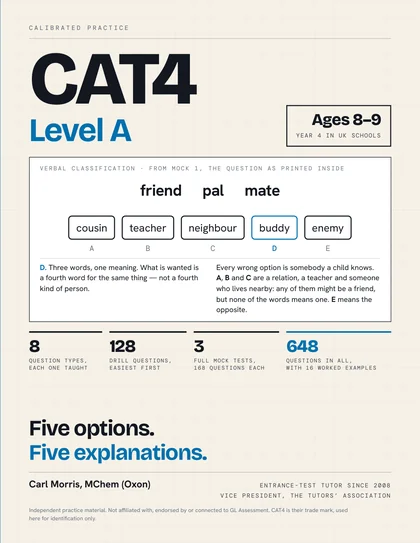
Front cover of CAT4 Level A Practice Book: Year 4, Ages 8-9
  • 8question types, each one taught
  • 128drill questions, easiest first
  • 3full mock tests, 168 questions each
  • 648questions in all, with 16 worked examples

Is this the right book?

Level A is the version a school normally uses in Year 4, with children aged 8–9. The school chooses the level from the year group, not the parent.

If your child is in a different year, find the right level. If in doubt, ask the school which level it uses.

What is in it

  • Eight taught chapters, one per question type: the method, the traps that catch children out, two worked examples, then 16 drill questions from easy to hard.
  • Three complete mock tests of 168 questions, in the real three-part order and to the published time limits, with an error grid to mark against.
  • 648 worked answers, not 648 answer letters. Every question explains the option that is right and the four that are not.
  • A chapter for the adult: reading the school’s report, pacing, English as an additional language, access arrangements, and when to stop.

The Level A paper

Question typePartQuestionsMinutes
Figure Classification 1 24 10
Figure Matrices 1 24 10
Verbal Classification 2 24 8
Verbal Analogies 2 24 8
Number Analogies 2 18 10
Number Series 3 18 8
Figure Analysis 3 18 9
Figure Recognition 3 18 9
Total16872

Structure and timings as published by GL Assessment for Levels A to G. The mock tests in the book follow them exactly.

From the book

One question of each type, answered the way the book answers it.

These are worked examples printed in the Level A book. Try each one, then open the answer: all five options are explained, and each wrong one has its trap named.

Non-Verbal Reasoning · Part 1 · 24 questions in 10 minutes

Figure Classification

Three figures sit in a row on the left. They have something in common. On the right are five more figures, labelled A to E, and exactly one of them shares that same something. The instruction never tells you what the rule is; finding it is the question.

Traps the chapter names: shape-match · near-miss · salient · none

Figure Classification at other levels

Figure Classification · worked example

ABCDE
Show the answer, and why each of the other four is wrongHide the answer
Answer E
The rule: every figure is a drop. The shading and size vary, so neither can be the rule.
E (grey drop) is the only option that fits it.A is a leaf, not a drop.B is a cloud, not a drop.C is a heart, not a drop.D is a circle, not a drop.Traps: A salient · B salient · C salient · D salient

Non-Verbal Reasoning · Part 1 · 24 questions in 10 minutes

Figure Matrices

Three figures and one empty cell, marked with a question mark, make a square, two by two. Five options sit below. The figures in the grid follow a rule, and the option that completes the grid is the answer.

Traps the chapter names: unchanged · repeated · double · reversed · wrong-feature · extra · wrong-step

Figure Matrices at other levels

Figure Matrices · worked example

?ABCDE
Show the answer, and why each of the other four is wrongHide the answer
Answer D
The top-left figure gets one size bigger to give the top-right figure.
Apply the same change to the bottom-left figure (medium black triangle) and you get large black triangle, which is D.A makes the change the wrong way round.B changes the shading instead of the size.C makes the right change, then also changes the shading, which the top row never changes.E changes the shape instead of the size.Traps: A reversed · B wrong-feature · C extra · E wrong-feature

Verbal Reasoning · Part 2 · 24 questions in 8 minutes

Verbal Classification

Three words are given. They belong together in some way. Of the five words below, one belongs with them and four do not. Choose the one that belongs.

Traps the chapter names: near-category · associated · opposite

Verbal Classification at other levels

Verbal Classification · worked example

run walk hop
AsitBwaveCswimDjogEkick
Show the answer, and why each of the other four is wrongHide the answer
Answer D
The group: ways of moving along on your feet.
D (jog) fits. To jog is a way of moving along on your feet.A (sit) means to rest on a seat without moving along.B (wave) is something you do with your hand, not your feet.C (swim) moves you through water using your arms and legs, not walking on your feet.E (kick) uses your foot, but it does not move you along.Traps: A near-category · B near-category · C near-category · E near-category

Verbal Reasoning · Part 2 · 24 questions in 8 minutes

Verbal Analogies

A pair of words is given with an arrow between them, then a third word with an arrow and a question mark: kitten → cat : puppy → ? The first pair are related in some way; choose the option that is related to the third word in exactly the same way.

Traps the chapter names: associated · reversed · wrong-relation · opposite

Verbal Analogies at other levels

Verbal Analogies · worked example

sheep → baa : cow → ?
AmooBchewClieDoinkEkick
Show the answer, and why each of the other four is wrongHide the answer
Answer A
The link: sheep → baa, animal → the sound it makes.
cow → moo is A. A sheep says baa, and a cow says moo.B (chew) is what a cow does with grass, not the sound it makes.C (lie) is something a cow does when resting, not a sound.D (oink) is the sound a pig makes, not a cow.E (kick) is something a cow can do with its legs, not a sound.Traps: B associated · C associated · D wrong-relation · E associated

Quantitative Reasoning · Part 2 · 18 questions in 10 minutes

Number Analogies

Three pairs of numbers in square brackets. In the first two pairs, the second number has been made from the first by the same rule. The third pair has a question mark; apply the rule to its first number and choose the result from the five options.

Traps the chapter names: wrong-op · off-by-one · reversed · half · wrong-elem · near

Number Analogies at other levels

Number Analogies · worked example

[15 → 13] [8 → 6] [11 → ?]
A16B7C9D11E12
Show the answer, and why each of the other four is wrongHide the answer
Answer C
Find what turns 15 into 13 and check it also turns 8 into 6: subtract 2.
Apply it to 11: 9. That is C.A is seven more than the answer: it does not follow the rule.B is two less than the answer.D is two more than the answer.E is three more than the answer: it does not follow the rule.Traps: A near · B near · D near · E near

Quantitative Reasoning · Part 3 · 18 questions in 8 minutes

Number Series

A row of numbers with a question mark at the end. The numbers follow a rule; choose the option that comes next.

Traps the chapter names: off-by-one · near · flat-step · wrong-step · skip · wrong-op · wrong-series

Number Series at other levels

Number Series · worked example

15 85 20 82 25 79 ?
A27B30C23D28E29
Show the answer, and why each of the other four is wrongHide the answer
Answer B
The gaps: +70, −65, +62, −57, +54. The rule: two counts go in turn: the 1st, 3rd and 5th numbers go up by 5; the 2nd, 4th and 6th numbers go down by 3; the 7th number is on the first count.
The next term is 30, which is B.A is three less than the answer: it does not continue the rule.C is seven less than the answer: it does not continue the rule.D is two less than the answer: it does not continue the rule.E is one less than the answer.Traps: A near · C near · D near · E off-by-one

Spatial Ability · Part 3 · 18 questions in 9 minutes

Figure Analysis

A square of paper is folded once — or, in the last few questions, twice — and then punched with one or two holes that go through every layer. Five options show unfolded squares with holes in them. Choose the one that shows how the paper looks when it is opened out again. In the pictures, a dashed line is the fold about to be made and the arrow shows which part swings over.

Traps the chapter names: skip-fold · wrong-axis · mirrored · rotated / shifted · extra-fold / over-unfold

Figure Analysis at other levels

Figure Analysis · worked example

ABCDE
Show the answer, and why each of the other four is wrongHide the answer
Answer A
Folds, in order: the left half is folded over onto the right. 1 hole punched through every layer.
Open the paper one fold at a time, last fold first. Each fold you undo makes a mirror copy of every hole that was under its flap across that fold line, so the count goes 1 → 2 — doubling at every fold. That is A.B has the right number of holes but the pattern is turned upside down (a half turn) — the holes are not where the folds put them.C reflects across a fold that was never made, so it has 4 holes where the folds give 2.D has the right number of holes but the pattern is turned a quarter turn — the holes are not where the folds put them.E mirrors the holes the wrong way, across instead of over the fold.Traps: B rotated · C extra-fold · D rotated · E wrong-axis

Spatial Ability · Part 3 · 18 questions in 9 minutes

Figure Recognition

A simple shape is shown on the left. On the right are five more complicated figures, each made of many lines. The simple shape is hidden inside exactly one of them, at the same size and the same way round, and the question is which.

Traps the chapter names: rotated · mirrored · stretched · altered · absent

Figure Recognition at other levels

Figure Recognition · worked example

ABCDE
Show the answer, and why each of the other four is wrongHide the answer
Answer D
Look for the shape at the same size and the same way round, with every line there.
D has the shape in it, the same size and the same way round.A has a shape that is nearly right, but one corner or one end is different.B has a shape that is nearly right, but one corner or one end is different.C has the shape turned round, so it is not the same way up.E has the shape turned round, so it is not the same way up.Traps: A altered · B altered · C rotated · E rotated

No surprises on the day.

CAT4 Level A, for Year 4. 648 questions, every option explained.

Questions about Level A

Is Level A the right level for my child?

Level A is the version a school normally uses in Year 4, with children aged 8–9. The school chooses the level from the year group, not from ability. If you are not sure, ask the school which level it uses before you buy.

How long is the CAT4 Level A test?

The timed tests add up to 72 minutes for 168 questions, in three parts, usually sat with breaks between them: Figure Classification (24 questions, 10 minutes); Figure Matrices (24 questions, 10 minutes); Verbal Classification (24 questions, 8 minutes); Verbal Analogies (24 questions, 8 minutes); Number Analogies (18 questions, 10 minutes); Number Series (18 questions, 8 minutes); Figure Analysis (18 questions, 9 minutes); Figure Recognition (18 questions, 9 minutes).

What is in the book?

648 original questions: 16 worked examples, 128 drill questions ordered from easy to hard, and three full mock tests of 168 questions to the published time limits, each with an error grid. Every answer explains all five options. A final part for the adult covers the school's report, pacing, English as an additional language and access arrangements.

What changed in the November 2026 revised edition?

New kinds of figure question, recalibrated number and shape questions, and fuller answers: every wrong option in the word questions now has its own reason, and figure answers show a small picture of the right option.