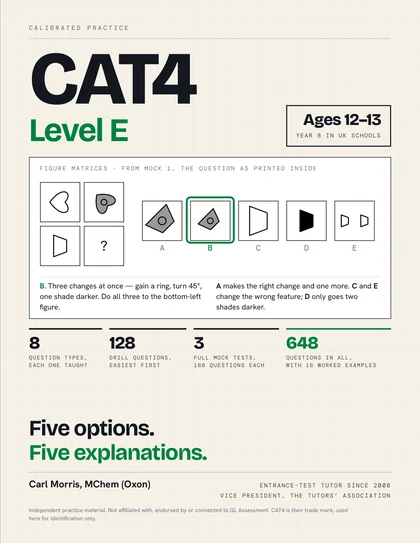
648 questions, and every one of them explains all five options. All eight question types taught
before they are tested, then three complete mock tests. For the child who says “I just guessed”.
Paperback, 8.5 × 11 in, 295 pages. Revised edition, November 2026. ISBN 979-8-17-476602-0.
8question types, each one taught
128drill questions, easiest first
3full mock tests, 168 questions each
648questions in all, with 16 worked examples
Is this the right book?
Level E is the version a school normally uses in Year 8, with children aged 12–13. The school chooses
the level from the year group, not the parent.
If your child is in a different year, find the right level. If in doubt, ask the school which level it uses.
What is in it
Eight taught chapters, one per question type: the method, the traps that catch children out, two worked examples, then 16 drill questions from easy to hard.
Three complete mock tests of 168 questions, in the real three-part order and to the published time limits, with an error grid to mark against.
648 worked answers, not 648 answer letters. Every question explains the option that is right and the four that are not.
A chapter for the adult: reading the school’s report, pacing, English as an additional language, access arrangements, and when to stop.
Structure and timings as published by GL Assessment for Levels A to G. The mock tests in the book follow them exactly.
From the book
One question of each type, answered the way the book answers it.
These are worked examples printed in the Level E book. Try each one, then open the answer: all five options are explained, and each wrong one has its trap named.
Non-Verbal Reasoning · Part 1 · 24 questions in 10 minutes
Figure Classification
Three figures sit in a row on the left. They have something in common. On the right are five more figures, labelled A to E, and exactly one of them shares that same something. The instruction never tells you what the rule is; finding it is the question.
Show the answer, and why each of the other four is wrongHide the answer
Answer C
The rule: every figure pairs a grey straight-sided shape with a black closed free-form outline (a cloud, leaf, flower and so on). The shapes themselves change from figure to figure, so they cannot be the rule.
C (two parts: black splash, grey triangle) is the only option that fits it.A pairs the shape with an open line, not a closed free-form outline.B has a white straight-sided shape, not a grey one.D has the shadings the wrong way round.E has two straight-sided shapes and no free-form outline.Traps: A salient · B near-miss · D half-rule · E half-rule
Non-Verbal Reasoning · Part 1 · 24 questions in 10 minutes
Figure Matrices
Figures are arranged in a square grid, two by two or three by three, with one cell empty and marked with a question mark. Five options sit below. The figures in the grid follow a rule, and the option that completes the grid is the answer.
Show the answer, and why each of the other four is wrongHide the answer
Answer D
The top-left figure gets darker (one shade) and gets a dashed outline and turns a quarter turn clockwise to give the top-right figure.
Apply the same change to the bottom-left figure (large white semicircle turned 270°) and you get large grey semicircle with a dashed outline, turned back to 0° (not turned at all), which is D.A changes the size instead of the outline and the shading and the turn.B makes the right change, then also changes the size, which the top row never changes.C is the bottom-left figure left exactly as it was — the change has not been applied at all.E changes the number of shapes instead of the outline and the shading and the turn.Traps: A wrong-feature · B extra · C unchanged · E wrong-feature
Verbal Reasoning · Part 2 · 24 questions in 8 minutes
Verbal Classification
Three words are given. They belong together in some way. Of the five words below, one belongs with them and four do not. Choose the one that belongs.
Traps the chapter names: near-category · associated · opposite
Show the answer, and why each of the other four is wrongHide the answer
Answer B
The group: stretches of the day.
B (night) fits. Night is the stretch of the day after evening.A (clock) measures the time of day but is not a stretch of it.C (sunshine) is light from the sun, not a period of the day.D (midnight) is a single moment, not a stretch of time.E (week) is seven days, far longer than a part of one day.Traps: A associated · C associated · D near-category · E near-category
Verbal Reasoning · Part 2 · 24 questions in 8 minutes
Verbal Analogies
A pair of words is given with an arrow between them, then a third word with an arrow and a question mark: kitten → cat : puppy → ? The first pair are related in some way; choose the option that is related to the third word in exactly the same way.
Show the answer, and why each of the other four is wrongHide the answer
Answer E
The link: wool → sheep, a material → the animal it comes from.
leather → cow is E. Wool comes from sheep, and leather comes mainly from cows.A (herd) is the group cows live in, not the animal leather is taken from.B (farm) is the place cows are kept, not the animal leather comes from.C (shoe) is something made from leather, not the animal it comes from.D (hen) is a bird kept for eggs and meat; its skin is not made into leather.Traps: A wrong-relation · B associated · C wrong-relation · D wrong-relation
Quantitative Reasoning · Part 2 · 18 questions in 10 minutes
Number Analogies
Three pairs of numbers in square brackets. In the first two pairs, the second number has been made from the first by the same rule. The third pair has a question mark; apply the rule to its first number and choose the result from the five options.
Traps the chapter names: wrong-op · off-by-one · reversed · half · order · wrong-elem · near
Show the answer, and why each of the other four is wrongHide the answer
Answer D
Find what turns 6 into 3 and check it also turns 30 into 11: divide by 3 then add 1.
Apply it to 27: 10. That is D.A is the rule applied to the wrong number.B divides by 3 but forgets the second step.C does the second step the wrong way.E is four more than the answer: it does not follow the rule.Traps: A wrong-elem · B half · C reversed · E near
Quantitative Reasoning · Part 3 · 18 questions in 8 minutes
Number Series
A row of numbers with a question mark at the end. The numbers follow a rule; choose the option that comes next.
Traps the chapter names: off-by-one · near · flat-step · wrong-step · wrong-series · skip · wrong-op · order · half
Show the answer, and why each of the other four is wrongHide the answer
Answer C
The gaps: +1, +2, +3, +4. The rule: the steps grow: +1, +2, +3, … each step is 1 more than the last.
The next term is 25, which is C.A repeats the last step instead of growing it.B is the term after the answer: it goes one term too far.D is one more than the answer.E is seven less than the answer: it does not continue the rule.Traps: A flat-step · B skip · D off-by-one · E near
Spatial Ability · Part 3 · 18 questions in 9 minutes
Figure Analysis
A square of paper is shown being folded, one fold at a time, then punched with one, two or three holes that go through every layer. Five options show unfolded squares with holes in them. Choose the one that shows how the paper looks when it is opened out again. In the pictures, a dashed line is the fold about to be made and the arrow shows which part swings over. The paper is drawn pale grey. Where a flap swings out past the edge of the paper beneath it, that overhanging part is drawn a darker grey; the holes are always punched through the paler part, and through every layer under it.
Show the answer, and why each of the other four is wrongHide the answer
Answer A
Folds, in order: the top-right corner is folded down to the bottom-left; the top half is folded down onto the bottom. One square hole and one round hole punched through every layer. Each hole keeps its shape as the paper opens, so follow the round ones and the square ones separately.
Open the paper one fold at a time, last fold first. Each fold you undo reflects every hole that was under its flap across that fold line, so the count goes 2 → 3 → 6 — 6, not 8, because a flap only doubles the holes it actually covers, and a hole that a fold's flap did not reach gets no twin from that fold. That is A.B has the right number of holes but the pattern is turned a quarter turn — the holes are not where the folds put them.C has the right number of holes, but they are not where the folds put them.D has the right number of holes but the whole pattern has slid across the paper.E mirrors every hole across every fold, including a fold whose flap never covered that hole, so it has 8 holes where the folds give 6.Traps: B rotated · C shifted · D shifted · E over-unfold
Spatial Ability · Part 3 · 18 questions in 9 minutes
Figure Recognition
A simple shape is shown on the left. On the right are five more complicated figures, each made of many lines. The simple shape is hidden inside exactly one of them, at the same size and the same way round, and the question is which.
Show the answer, and why each of the other four is wrongHide the answer
Answer A
Look for the shape at the same size and the same way round, with every line there.
A contains it at the same size and the same way round.B contains a shape with one corner in the wrong place or one end cut short.C contains a shape with one corner in the wrong place or one end cut short.D contains a mirror image of the shape.E contains the shape turned round — the same lines, but not the same way up.Traps: B altered · C altered · D mirrored · E rotated
No surprises on the day.
CAT4 Level E, for Year 8. 648 questions, every option explained.
Independent practice material. Not affiliated with, endorsed by or connected to GL Assessment. CAT4 is a trade mark of GL Assessment Limited, used here for identification only. No official examination material is reproduced. Every question is original.
Questions about Level E
Is Level E the right level for my child?
Level E is the version a school normally uses in Year 8, with children aged 12–13. The school chooses the level from the year group, not from ability. If you are not sure, ask the school which level it uses before you buy.
How long is the CAT4 Level E test?
The timed tests add up to 72 minutes for 168 questions, in three parts, usually sat with breaks between them: Figure Classification (24 questions, 10 minutes); Figure Matrices (24 questions, 10 minutes); Verbal Classification (24 questions, 8 minutes); Verbal Analogies (24 questions, 8 minutes); Number Analogies (18 questions, 10 minutes); Number Series (18 questions, 8 minutes); Figure Analysis (18 questions, 9 minutes); Figure Recognition (18 questions, 9 minutes).
What is in the book?
648 original questions: 16 worked examples, 128 drill questions ordered from easy to hard, and three full mock tests of 168 questions to the published time limits, each with an error grid. Every answer explains all five options. A final part for the adult covers the school's report, pacing, English as an additional language and access arrangements.
What changed in the November 2026 revised edition?
New kinds of figure question, recalibrated number and shape questions, and fuller answers: every wrong option in the word questions now has its own reason, and figure answers show a small picture of the right option.