1. Home
  2. The ten levels
  3. Level D

Calibrated Practice

CAT4Level D

Ages 11–12Year 7 in UK schools

648 questions, and every one of them explains all five options. All eight question types taught before they are tested, then three complete mock tests. For the child who says “I just guessed”.

Paperback, 8.5 × 11 in, 293 pages. Revised edition, November 2026. ISBN 979-8-17-447348-5.

Front cover of CAT4 Level D Practice Book: Year 7, Ages 11-12
  • 8question types, each one taught
  • 128drill questions, easiest first
  • 3full mock tests, 168 questions each
  • 648questions in all, with 16 worked examples

Is this the right book?

Level D is the version a school normally uses in Year 7, with children aged 11–12. The school chooses the level from the year group, not the parent.

If your child is in a different year, find the right level. If in doubt, ask the school which level it uses.

What is in it

  • Eight taught chapters, one per question type: the method, the traps that catch children out, two worked examples, then 16 drill questions from easy to hard.
  • Three complete mock tests of 168 questions, in the real three-part order and to the published time limits, with an error grid to mark against.
  • 648 worked answers, not 648 answer letters. Every question explains the option that is right and the four that are not.
  • A chapter for the adult: reading the school’s report, pacing, English as an additional language, access arrangements, and when to stop.

The Level D paper

Question typePartQuestionsMinutes
Figure Classification 1 24 10
Figure Matrices 1 24 10
Verbal Classification 2 24 8
Verbal Analogies 2 24 8
Number Analogies 2 18 10
Number Series 3 18 8
Figure Analysis 3 18 9
Figure Recognition 3 18 9
Total16872

Structure and timings as published by GL Assessment for Levels A to G. The mock tests in the book follow them exactly.

From the book

One question of each type, answered the way the book answers it.

These are worked examples printed in the Level D book. Try each one, then open the answer: all five options are explained, and each wrong one has its trap named.

Non-Verbal Reasoning · Part 1 · 24 questions in 10 minutes

Figure Classification

Three figures sit in a row on the left. They have something in common. On the right are five more figures, labelled A to E, and exactly one of them shares that same something. The instruction never tells you what the rule is; finding it is the question.

Traps the chapter names: shape-match · near-miss · half-rule · salient · none

Figure Classification at other levels

Figure Classification · worked example

ABCDE
Show the answer, and why each of the other four is wrongHide the answer
Answer E
The rule: every figure has a black dot at its bottom-left corner. The shape and shading vary, so neither can be the rule.
E (grey pentagon with a black dot at its bottom-left corner) is the only option that fits it.A has its dot at its bottom-right corner, not at its bottom-left corner.B has its dot at its top-left corner, not at its bottom-left corner.C has no dot at all.D has its dot at its top-right corner, not at its bottom-left corner.Traps: A near-miss · B near-miss · C shape-match · D shape-match

Non-Verbal Reasoning · Part 1 · 24 questions in 10 minutes

Figure Matrices

Figures are arranged in a square grid, usually two by two and sometimes three by three, with one cell empty and marked with a question mark. Five options sit below. The figures in the grid follow a rule, and the option that completes the grid is the answer. When a figure gains or loses copies, the copies are drawn smaller so that they fit the box; that is not a change of size. Where the answers give a turn in degrees, it is measured clockwise from the way the shape is first drawn: an arrow at 0° points to the right, and a heart or a trapezium at 0° stands the usual way up.

Traps the chapter names: unchanged · repeated · double · reversed · half · wrong-feature · extra · wrong-step · row-only / col-only · third-rule · neighbour · other-op

Figure Matrices at other levels

Figure Matrices · worked example

?ABCDE
Show the answer, and why each of the other four is wrongHide the answer
Answer D
The top-left figure gets a dashed outline to give the top-right figure.
Apply the same change to the bottom-left figure (medium grey oval) and you get medium grey oval with a dashed outline, which is D.A changes the mark inside instead of the outline.B makes the right change, then also changes the size, which the top row never changes.C changes the size instead of the outline.E is the bottom-left figure left exactly as it was — the change has not been applied at all.Traps: A wrong-feature · B extra · C wrong-feature · E unchanged

Verbal Reasoning · Part 2 · 24 questions in 8 minutes

Verbal Classification

Three words are given. They belong together in some way. Of the five words below, one belongs with them and four do not. Choose the one that belongs.

Traps the chapter names: near-category · associated · opposite

Verbal Classification at other levels

Verbal Classification · worked example

oak beech elm
AbirchBdaisyCacornDbrambleEtimber
Show the answer, and why each of the other four is wrongHide the answer
Answer A
The group: trees.
A (birch) fits. A birch is a tree, like the oak, beech and elm.B (daisy) is a small flowering plant, not a tree.C (acorn) is the nut of an oak tree, not a tree itself.D (bramble) is a prickly bush that grows blackberries, not a tree.E (timber) is wood cut from trees for building, not a living tree.Traps: B near-category · C associated · D near-category · E associated

Verbal Reasoning · Part 2 · 24 questions in 8 minutes

Verbal Analogies

A pair of words is given with an arrow between them, then a third word with an arrow and a question mark: kitten → cat : puppy → ? The first pair are related in some way; choose the option that is related to the third word in exactly the same way.

Traps the chapter names: associated · reversed · from-pair · wrong-relation · opposite

Verbal Analogies at other levels

Verbal Analogies · worked example

potter → pottery : baker → ?
AapronBrecipeCflourDovenEbread
Show the answer, and why each of the other four is wrongHide the answer
Answer E
The link: potter → pottery, worker → what they make.
baker → bread is E. A potter makes pottery, and a baker makes bread.A (apron) is what a baker wears to keep clean, not what they make.B (recipe) is the set of instructions a baker follows, not the product they make.C (flour) is the raw ingredient a baker uses, not the finished thing they make.D (oven) is the equipment a baker cooks in, not what they produce.Traps: A associated · B wrong-relation · C associated · D associated

Quantitative Reasoning · Part 2 · 18 questions in 10 minutes

Number Analogies

Three pairs of numbers in square brackets. In the first two pairs, the second number has been made from the first by the same rule. The third pair has a question mark; apply the rule to its first number and choose the result from the five options.

Traps the chapter names: wrong-op · off-by-one · reversed · half · order · wrong-elem · near

Number Analogies at other levels

Number Analogies · worked example

[12 → 108] [8 → 72] [3 → ?]
A21B30C7D27E28
Show the answer, and why each of the other four is wrongHide the answer
Answer D
Find what turns 12 into 108 and check it also turns 8 into 72: multiply by 9.
Apply it to 3: 27. That is D.A is six less than the answer: it does not follow the rule.B multiplies by 10.C is 20 less than the answer: it does not follow the rule.E is one more than the answer.Traps: A near · B wrong-op · C near · E off-by-one

Quantitative Reasoning · Part 3 · 18 questions in 8 minutes

Number Series

A row of numbers with a question mark at the end. The numbers follow a rule; choose the option that comes next.

Traps the chapter names: off-by-one · near · flat-step · wrong-step · wrong-series · skip · wrong-op · order · half

Number Series at other levels

Number Series · worked example

1 2 4 8 16 ?
A38B34C40D31E32
Show the answer, and why each of the other four is wrongHide the answer
Answer E
The gaps: +1, +2, +4, +8. The rule: multiply by 2 each time.
The next term is 32, which is E.A is six more than the answer: it does not continue the rule.B is two more than the answer: it does not continue the rule.C is eight more than the answer: it does not continue the rule.D is one less than the answer.Traps: A near · B near · C near · D off-by-one

Spatial Ability · Part 3 · 18 questions in 9 minutes

Figure Analysis

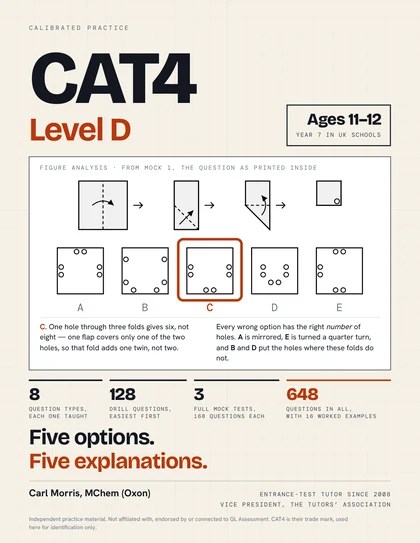
A square of paper is shown being folded, one fold at a time, then punched with one or two holes that go through every layer. Five options show unfolded squares with holes in them. Choose the one that shows how the paper looks when it is opened out again. In the pictures, a dashed line is the fold about to be made and the arrow shows which part swings over. The paper is drawn pale grey. Where a flap swings out past the edge of the paper beneath it, that overhanging part is drawn a darker grey; the holes are always punched through the paler part, and through every layer under it.

Traps the chapter names: no-unfold · skip-fold · wrong-axis · mirrored · rotated / shifted · extra-fold / over-unfold

Figure Analysis at other levels

Figure Analysis · worked example

ABCDE
Show the answer, and why each of the other four is wrongHide the answer
Answer C
Folds, in order: the bottom half is folded up onto the top; the right half is folded over onto the left. One square hole punched through every layer.
Open the paper one fold at a time, last fold first. Each fold you undo reflects every hole that was under its flap across that fold line, so the count goes 1 → 2 → 4 — doubling at every fold. That is C.A forgets one of the folds (the right half is folded over onto the left), so it has 2 holes where the folds give 4.B has the right number of holes, but they are not where the folds put them.D has the right number of holes but the pattern is turned a quarter turn — the holes are not where the folds put them.E has the right number of holes but the whole pattern has slid across the paper.Traps: A skip-fold · B shifted · D rotated · E shifted

Spatial Ability · Part 3 · 18 questions in 9 minutes

Figure Recognition

A simple shape is shown on the left. On the right are five more complicated figures, each made of many lines. The simple shape is hidden inside exactly one of them, at the same size and the same way round, and the question is which.

Traps the chapter names: rotated · mirrored · altered · absent

Figure Recognition at other levels

Figure Recognition · worked example

ABCDE
Show the answer, and why each of the other four is wrongHide the answer
Answer C
Look for the shape at the same size and the same way round, with every line there.
C contains it at the same size and the same way round.A has lines that look similar, but no copy of the shape at the same size, whichever way round.B has lines that look similar, but no copy of the shape at the same size, whichever way round.D contains a shape with one corner in the wrong place or one end cut short.E contains a mirror image of the shape.Traps: A absent · B absent · D altered · E mirrored

No surprises on the day.

CAT4 Level D, for Year 7. 648 questions, every option explained.

Questions about Level D

Is Level D the right level for my child?

Level D is the version a school normally uses in Year 7, with children aged 11–12. The school chooses the level from the year group, not from ability. If you are not sure, ask the school which level it uses before you buy.

How long is the CAT4 Level D test?

The timed tests add up to 72 minutes for 168 questions, in three parts, usually sat with breaks between them: Figure Classification (24 questions, 10 minutes); Figure Matrices (24 questions, 10 minutes); Verbal Classification (24 questions, 8 minutes); Verbal Analogies (24 questions, 8 minutes); Number Analogies (18 questions, 10 minutes); Number Series (18 questions, 8 minutes); Figure Analysis (18 questions, 9 minutes); Figure Recognition (18 questions, 9 minutes).

What is in the book?

648 original questions: 16 worked examples, 128 drill questions ordered from easy to hard, and three full mock tests of 168 questions to the published time limits, each with an error grid. Every answer explains all five options. A final part for the adult covers the school's report, pacing, English as an additional language and access arrangements.

What changed in the November 2026 revised edition?

New kinds of figure question, recalibrated number and shape questions, and fuller answers: every wrong option in the word questions now has its own reason, and figure answers show a small picture of the right option.